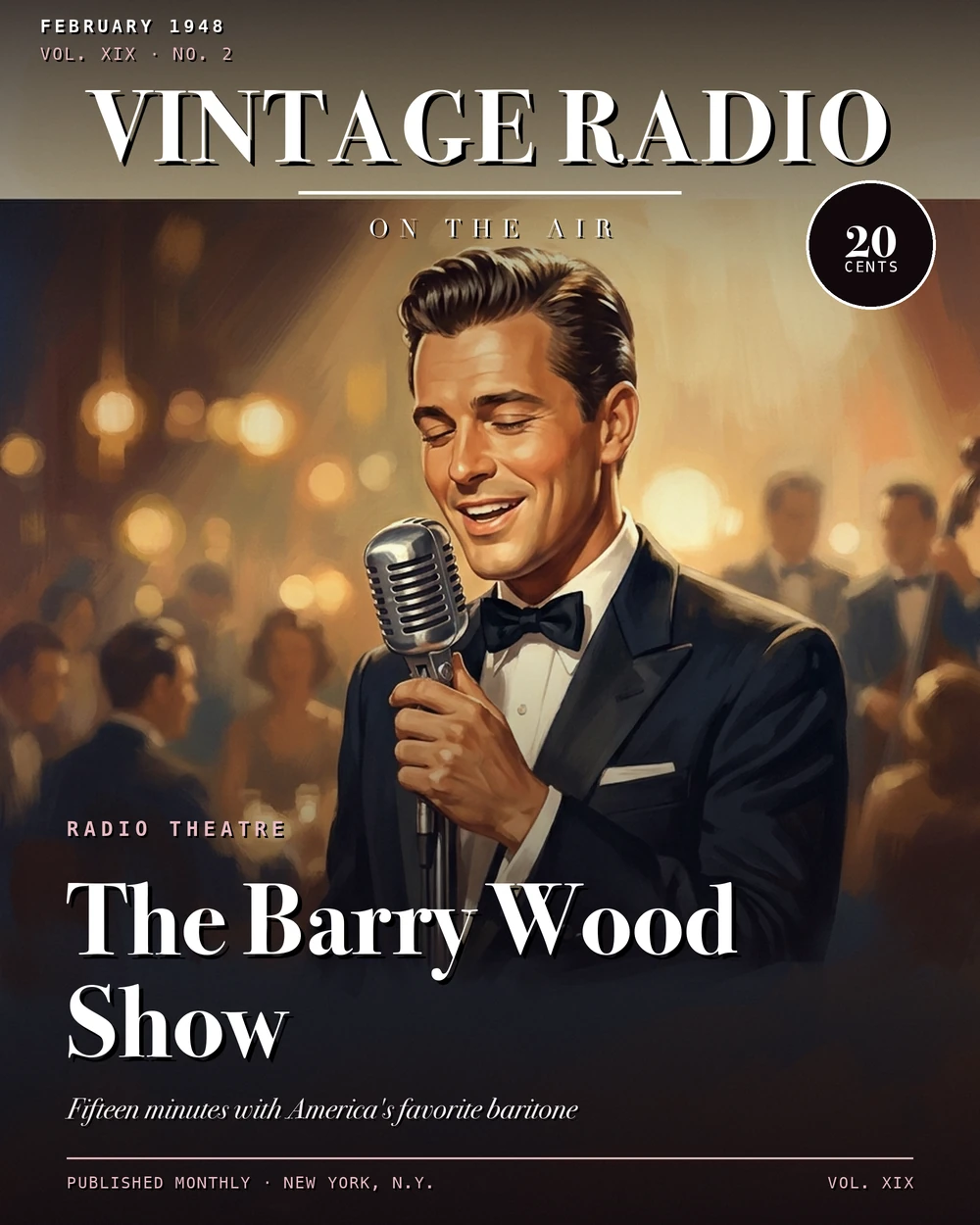
The Barry Wood Show
The Man Behind the Microphone
Barry Wood arrived at his own syndicated program with a longer radio résumé than most listeners probably realized. Born Louis Rappaport on February 12, 1909, in New Haven, Connecticut — the younger brother of bandleader Barney Rapp — he came up through the big-band circuit of the 1920s and 1930s, playing saxophone and clarinet and singing with the orchestras of Abe Lyman, Paul Ash, and Vincent Lopez, and working as a sideman for Buddy Rogers's band. He attended Yale University, where he swam and played water polo, before the music business pulled him in full time.
His biggest early claim to fame was as the lead male vocalist on NBC's Your Hit Parade, a position that put him squarely in front of the country's largest radio audience. He was promoted there as the nation's "sweater boy," an image that matched the show's wholesome, mass-appeal identity. In 1941 he became identified with Irving Berlin's "Any Bonds Today?" and "Arms for the Love of America," wartime songs that got a great deal of airplay. Then, in 1943, Frank Sinatra replaced him on Your Hit Parade — a transition that said something about where popular taste was heading, even if Wood's career was far from over.
From Your Hit Parade to the Ziv Syndicate
After leaving Your Hit Parade, Wood didn't step back from radio. He had his own NBC network show from 1943 to 1945, which started as The Million Dollar Band and later became the Palmolive Party with actress Patsy Kelly as co-star. In 1942, recording as Barry Wood and the Wood Nymphs, he had a hit with "We Did It Before (And We Can Do It Again)," written by Charles Tobias and Cliff Friend — a wartime anthem that eventually turned up in Warner Bros. Looney Tunes cartoons.
The Barry Wood Show itself was a different kind of production: a quarter-hour program syndicated in 1948 by the Frederick Ziv Company via electrical transcription. That meant pre-recorded discs were shipped to local stations, allowing the program to air in multiple markets on whatever schedule each station chose. Ziv invested heavily in the venture. Billboard reported that three quarter-hour musical programs the company contracted for — each running 130 discs — represented a combined investment of $750,000, with the bulk going to performer fees. Wood was billed as "America's favorite baritone," backed by guest vocalist Margaret Whiting, the vocal ensemble the Melody Maids, and Henry Sylvern and His Orchestra.
What the Show Sounded Like
The format was straightforward: vocal performances, some light comedy, and occasional celebrity interviews, with guest performers contributing both original songs and covers of contemporary hits. The music leaned into jazz and swing. Four episodes survive in the catalog, and the opening songs across those episodes give a fair sense of the range — "Foot Loose And Fancy Free," "Sweet Sue," "I'm Looking Over A Four Leaf Clover," and "Sing Something Simple." Nothing confrontational, nothing experimental; this was quarter-hour radio designed to fit comfortably into a local station's afternoon or evening schedule.
After Radio
Wood moved into television production after his radio years ended, and he moved into it at a fairly high level. His credits included producing Kate Smith's television show, Wide Wide World on NBC (1955–1958), and — perhaps most notably — serving as executive producer of The Bell Telephone Hour from 1959 to 1965, through Henry Jaffe Enterprises, Inc. That last credit connects him to one of television's better-regarded music programs, though the connection is professional and biographical rather than anything carried over from the radio era. He died in Miami Beach, Florida, on July 19, 1970.
The Barry Wood Show is not widely remembered today, which is understandable given how many quarter-hour musical syndication packages were produced in the late 1940s. But the four surviving episodes offer a clean example of how the Ziv model worked — local-friendly, polished, built around an established name — and Wood himself had enough history behind him to make the billing as "America's favorite baritone" something more than idle promotion.